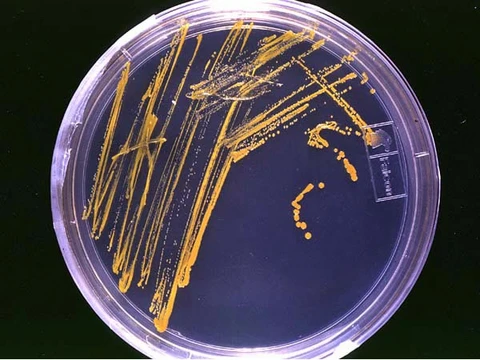
Bacterial capsule
Polysaccharide layer that shields bacteria and enables disease.

Doc. RNDr. Josef Reischig, CSc. · CC BY-SA 3.0
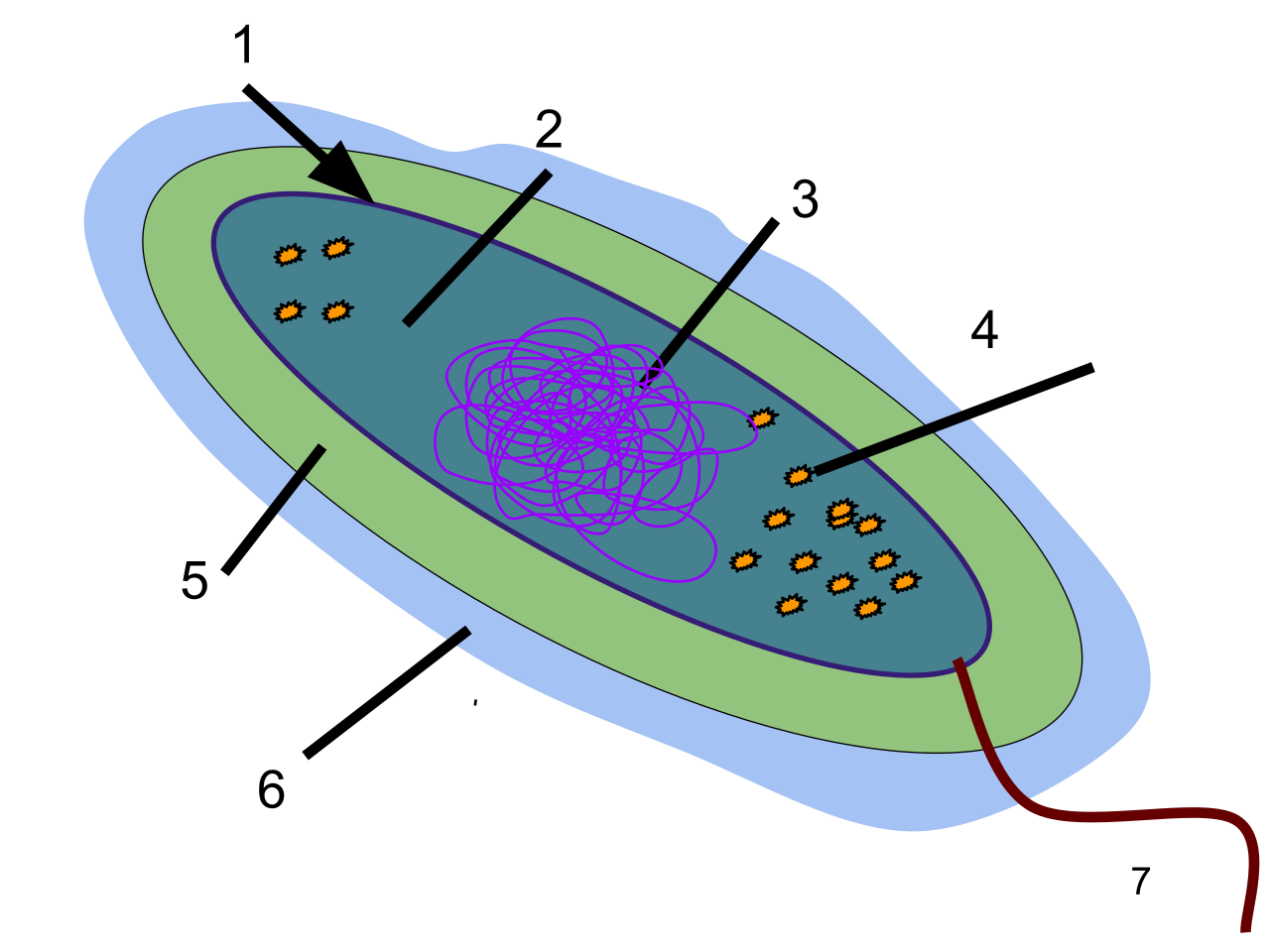
The bacterial capsule is a large, well-organized polysaccharide layer that lies outside the cell envelope of many bacteria, forming part of the outer envelope. It is a common structure found in both gram-negative and gram-positive bacteria, though it is distinct from the outer membrane of gram-negative bacteria. The capsule is a virulence factor that enhances the ability of bacteria to cause disease, and its presence is associated with various infections.
- composition
- Mostly polysaccharide; some species use poly-D-glutamic acid (e.g., Bacillus anthracis)
- function
- Protection from toxins, drying out, and phagocytosis; aids adhesion; can hinder biofilm formation
- visualization
- India ink staining or Maneval's capsule stain; appears as a clear halo
- common in
- Gram-negative bacteria (e.g., Escherichia coli, Neisseria meningitidis, Klebsiella pneumoniae)
- also in
- Some gram-positive bacteria (e.g., Streptococcus pneumoniae, Bacillus anthracis)
- vaccination use
- Capsular material used in vaccines against Haemophilus influenzae type b, S. pneumoniae, and N. meningitidis
Lore & Background
The capsule serves as a shield, protecting bacteria from toxins, drying out, and phagocytosis by eukaryotic cells such as macrophages. It also helps cells adhere to surfaces, though in many species a thick capsule can negatively affect biofilm formation by interfering with adhesins. Capsules are considered virulence factors because they enhance the ability to cause disease. Capsular material is antigenic, and specific antibodies may be required for phagocytosis. Immunity to one capsule type does not confer immunity to others. Capsules are found in many gram-negative bacteria, including Escherichia coli, Neisseria meningitidis, and Klebsiella pneumoniae, as well as some gram-positive bacteria like Streptococcus pneumoniae, which has at least 91 capsular serotypes used in pneumococcal vaccines.
Reader's Guide
The bacterial capsule is significant in microbiology and medicine because it is a key virulence factor that enables bacteria to evade the host immune system, particularly by preventing phagocytosis. Its presence is associated with diseases caused by organisms such as Haemophilus influenzae, Neisseria meningitidis, and Streptococcus pneumoniae. Capsular material is used in vaccines, though polysaccharides are not highly antigenic, especially in children; conjugation with protein carriers like tetanus or diphtheria toxoid stimulates a stronger immune response. The capsule also aids in adhesion to surfaces, but in some species it can hinder biofilm formation. Understanding capsule diversity—such as the 91 serotypes of S. pneumoniae—is critical for vaccine development and epidemiological tracking. The capsule's role in protection from environmental stresses and its antigenic properties make it a central target for both diagnostic methods (e.g., quellung reaction) and therapeutic interventions.
Did You Know?
- Most bacterial capsules are composed of polysaccharide, but Bacillus anthracis uses poly-D-glutamic acid.
- Capsules appear as a bright halo around the cell when stained with India ink because the ink cannot penetrate the capsule.
- Streptococcus pneumoniae has at least 91 different capsular serotypes, which are the basis for pneumococcal vaccines.
- Capsular vaccines for Haemophilus influenzae type b, S. pneumoniae, and N. meningitidis often use polysaccharides conjugated with protein carriers to improve immune response.
Structure and Chemical Composition
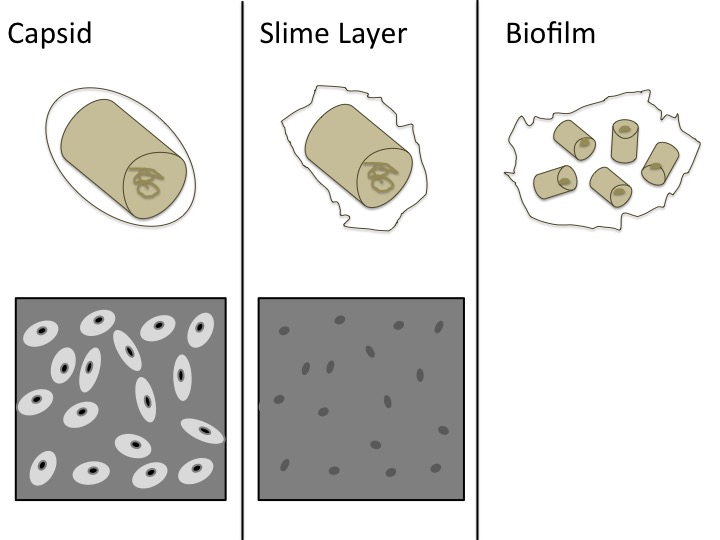
The bacterial capsule is a substantial, well-organized layer that sits outside the cell envelope, effectively becoming part of the outer boundary of the cell. Unlike the bacterial outer membrane—which houses lipopolysaccharides and lipoproteins and appears exclusively in gram-negative organisms—the capsule is a distinct structural entity found in both gram-positive and gram-negative species. Its primary chemical building block is polysaccharide, which may be either a homopolymer or a heteropolymer, though a notable exception exists: Bacillus anthracis constructs its capsule from poly-D-glutamic acid rather than sugar. The capsule is tightly packed and firmly attached, resisting removal by simple washing. When the same viscid secretion diffuses outward and remains as a loose, undemarcated coating in the surrounding medium, it is reclassified as a slime layer. Together, these two forms are often grouped under the umbrella term glycocalyx. The dense packing of the capsule makes it notoriously difficult to penetrate with conventional stains, a property that has shaped both its study and its biological role.
Biological Functions and Virulence
The capsule acts as a multifaceted shield for the bacterial cell. Its high water content buffers the organism against desiccation, while its physical barrier repels hydrophobic toxic substances such as detergents and excludes bacteriophages. In the context of infection, the capsule is a critical virulence factor: it prevents phagocytosis by eukaryotic cells like macrophages, and a capsule-specific antibody is generally required before engulfment can proceed. This immune-evasion capability is why encapsulated bacteria are so often associated with serious disease. The capsule also mediates adhesion, helping cells attach to surfaces. Paradoxically, in certain species the capsule can hinder biofilm formation; a very thick or hypermucoviscous capsule may physically block the adhesins—pili or fimbriae—that are essential for the initial attachment step of biofilm assembly. Importantly, immunity generated against one capsular type does not confer protection against other types, underscoring the antigenic diversity of these structures. Collectively, organisms bearing such a layer are referred to as polysaccharide-encapsulated or simply encapsulated bacteria.
Diversity Across Bacterial and Fungal Species
Although the capsule is most frequently encountered among gram-negative bacteria—including Escherichia coli (certain strains), Neisseria meningitidis, Klebsiella pneumoniae, Haemophilus influenzae, Pseudomonas aeruginosa, Salmonella, and Acinetobacter baumannii—it is by no means exclusive to that group. Several gram-positive species also produce capsules, each with a distinctive chemistry. Bacillus megaterium builds a hybrid capsule of polypeptide and polysaccharide, while Streptococcus pyogenes synthesizes a hyaluronic-acid capsule. Streptococcus pneumoniae stands out with at least 91 different capsular serotypes, a diversity that forms the foundation of pneumococcal vaccines. Streptococcus agalactiae produces nine antigenic capsule types, all containing sialic acid. Staphylococcus epidermidis, Staphylococcus aureus, and Lactococcus garvieae (which can sometimes make a hyaluronic acid capsule) round out the gram-positive list. Beyond bacteria, the yeast Cryptococcus neoformans possesses a structurally similar capsule. At the other extreme, capsules too small for ordinary light microscopy, such as the M protein of S. pyogenes, are termed microcapsules.
Visualization Techniques and Vaccination Applications
Because standard dyes cannot penetrate the densely packed capsule, special methods are needed to reveal it. In India ink staining, the dark background dye is excluded by the capsule, leaving a bright halo around the cell. Maneval's capsule stain uses Congo red as an acidic background dye (which shifts to a bluish-grey at the working pH) and fuchsine to pink-stain the bacterium, again producing a clear halo between the two. Serological visualization relies on the quellung reaction: mixing capsular material with a specific anticapsular serum increases the capsule's refractivity, making it appear swollen under the microscope. Clinically, capsular polysaccharides have been harnessed for vaccines against Haemophilus influenzae type b, Streptococcus pneumoniae, and Neisseria meningitidis. However, because free polysaccharides elicit a weak immune response—particularly in young children—modern formulations conjugate the polysaccharide to protein carriers such as tetanus toxoid or diphtheria toxoid, dramatically strengthening the resulting antibody response.
Gallery
More in Microbiology 1-24
Elsewhere in the Microbiology universe
Spotted an error? Know more?
This is a living reference — every entry is fact-audited, and reader corrections feed straight into our audit queue. Suggest an edit · See this site's audit record